
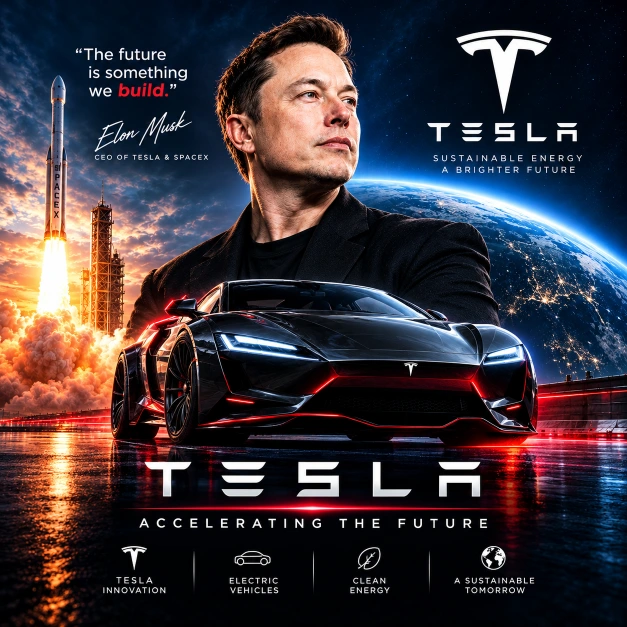
Tesla Flying Car: Price, Release Date & 7 Amazing Features
The Tesla flying car has become one of the biggest automotive talking points following Elon Musk’s unveiling of a redesigned Tesla Roadster equipped with SpaceX-inspired thrusters. During a demonstration in Texas on October 15, 2026, the electric sports car travelled along an inverted ramp, rotated in the air and jumped over other Tesla vehicles.
The demonstration showed technology that goes beyond what drivers normally expect from an electric sports car. However, it did not establish that the roadster can fly like a conventional aircraft or travel long distances through the air.
Tesla is targeting production in 2028, but the final retail price, delivery schedule and practical availability of the aerial features remain uncertain. Reports describe different Roadster versions, including configurations with specialised thrusters and substantial reservation deposits.
This guide explains what happened at the unveiling, how the technology is intended to work, what the reported specifications mean and why the Tesla flying car still faces important technical and regulatory challenges.
latest updates Lake Mead
What Is the Tesla Flying Car?
The Tesla flying car is a redesigned version of the second-generation Tesla Roadster, an electric sports car first announced in 2017. The latest concept combines an electric drivetrain with additional hardware inspired by SpaceX propulsion technology.
Unlike a conventional electric car, the thruster-equipped Roadster is designed to perform brief airborne manoeuvres. Reports also describe a suction system that allows the vehicle to maintain contact with an inverted surface during a demonstration.
According to TechCrunch’s coverage of the unveiling, Tesla presented three versions: Performance, Thrust and Rocket. The more specialised versions feature different levels of performance equipment, with the Rocket configuration described as the most extreme option.
The term ‘flying car’ needs some context. Tesla demonstrated short aerial movements, but it did not show sustained flight between destinations, normal aircraft-style take-offs or routine air travel.
For now, the vehicle is best understood as a high-performance electric sports car with experimental aerial capabilities. Whether those features will remain available in the final production models is an important question for potential buyers.
What Happened at the Tesla Flying Car October 2026 Demonstration?
The unveiling took place at a SpaceX facility in Texas and was livestreamed to viewers. Musk introduced the redesigned Roadster nearly nine years after Tesla first announced the next-generation model.
The demonstration featured several unusual manoeuvres.
- Inverted driving: The Roadster travelled along a curved ramp and held onto an upside-down section using a reported suction system.
- Mid-air rotation: The vehicle left the ramp, rotated in the air and returned to the ground.
- Jumping over vehicles: The demonstration also showed the Roadster moving above a line of Tesla vehicles.
The display was intended to showcase the combination of electric-car engineering and SpaceX-inspired technology. It also attracted attention because Tesla has repeatedly delayed the next-generation Roadster since its original announcement.
However, a demonstration is not the same as a completed production vehicle. The event did not establish the system’s long-term reliability, operating range in the air or suitability for everyday driving.
The remaining questions are especially important because the Roadster is intended to function as a road car as well as demonstrate unusual propulsion technology.
Watch Did Tesla Really Just Unveil a Flying Car?
The question behind the headlines is whether Tesla has genuinely created a flying car or demonstrated an experimental sports car capable of leaving the ground briefly.
In its coverage titled Watch: Did Tesla really just unveil a flying car?, the BBC examined the Roadster’s demonstration and the obstacles that could prevent such vehicles from becoming common on public roads. BBC technology editor Zoe Kleinman highlighted the difference between an impressive presentation and a technology that can be used safely in everyday life.
During the event, Musk said an audience was needed to demonstrate that the vehicle was not artificial intelligence-generated. The Roadster then performed its ramp manoeuvre, rotated in the air and landed using air jets.
Musk described the project as a collaboration between Tesla and SpaceX, while acknowledging that its success was not guaranteed.
The concept also has a longer history. Aviation pioneer Glenn Curtiss demonstrated an early flying-car prototype in 1917. Modern electric motors, batteries and propulsion systems have renewed interest in alternative transport designs, but the challenges of combining road driving with safe flight remain substantial.
A genuine practical flying car would need more than the ability to lift off. It would require dependable controls, suitable range, reliable emergency systems and approval for its intended operating environment.
For more reporting on the unveiling, read Dawn’s report on Elon Musk’s Tesla flying car, published on October 16, 2026.
The central point is simple: Tesla has demonstrated brief airborne manoeuvres, but the demonstration does not prove that the Roadster can replace an aircraft or become a routine flying vehicle.
How Do the SpaceX-Style Thrusters Work?
Cold-gas thrusters create force by releasing pressurised gas through nozzles. As gas moves out of a nozzle, it produces thrust in the opposite direction. Spacecraft use various thruster systems for movement and orientation, although installing similar technology in a road car presents different engineering requirements.
According to TechCrunch’s report, Tesla engineering executive Lars Moravy described a system using 10 thrusters connected to approximately 600 litres of compressed air.
The reported system combines several technologies:
- Electric motors: Provide the main propulsion for normal road driving.
- Cold-gas thrusters: Supply additional force for the demonstrated aerial manoeuvres.
- Suction equipment: Helps the vehicle remain attached to an inverted surface.
- Active aerodynamics: Adjusts airflow around the car to help manage performance and stability.
These components serve different purposes. The electric drivetrain moves the vehicle along the road, while the additional systems support specialised manoeuvres.
Integrating compressed-gas equipment into a sports car also raises questions about weight, available space, maintenance, reliability and passenger safety. The final design would need to address what happens if a thruster fails or the vehicle moves unexpectedly.
Until production specifications and independent tests become available, the reported hardware should be treated as a description of the demonstrated concept rather than proof of a fully validated production system.
Tesla Flying Car Specs and Performance
The following table summarises the specifications reported around the October 2026 unveiling. Some figures are claims or reported details, not independently verified production results.
| Feature | Reported information |
|---|---|
| Vehicle | Next-generation Tesla Roadster |
| Vehicle type | High-performance electric sports car |
| Special technology | SpaceX-inspired cold-gas thrusters on selected versions |
| Thruster system | Reportedly 10 thrusters and about 600 litres of compressed air |
| 0–60 mph acceleration | Claimed under one second for the advanced configuration |
| Top speed | Reportedly above 230 mph |
| Estimated range | Around 300 miles |
| Demonstrated aerial capability | Brief lifts, rotations and jumps |
| Performance and Thrust seating | Two seats, according to reports |
| Rocket seating | One seat, according to reports |
| Production target | 2028 |
| Final retail price | Not fully confirmed |
Reports describe acceleration from 0 to 60 mph in less than one second. However, the exact testing method matters when comparing that figure with other performance cars. The claim should not be treated as an independently verified result for a production vehicle.
The reported top speed of more than 230 mph and range of approximately 300 miles also require confirmation. Real-world range depends on speed, temperature, road conditions and the final vehicle configuration.
One of the most important unanswered questions is how the additional propulsion hardware will affect the finished car’s weight, efficiency and reliability. Independent testing will be needed to establish how closely the production model matches the claims made during the unveiling.
Tesla Roadster Versions: Performance, Thrust and Rocket
Reports describe three versions with different intended uses and equipment.
Performance of Tesla Flying Car
The performance version is described as the road-focused configuration. It seats two and includes active aerodynamics and a multi-mode suction system.
The reported reservation deposit is $50,000. This is a reservation amount, not confirmation of the vehicle’s total purchase price.
Thrust about the Tesla Flying Car
The Thrust version is intended to offer more extreme performance. Reports describe a two-seat layout with rear-mounted cold-gas thrusters.
Its reported reservation deposit is $250,000. The thruster system is associated with the claimed sub-one-second acceleration figure, although the final production specifications remain to be independently verified.
Rocket
The Rocket version is described as the most specialised configuration. Reports indicate that it has a single seat, 10 cold-gas thrusters and invitation-only availability.
It is the version most closely associated with the flying-car concept. However, its final price, delivery arrangements and permitted uses have not been fully established.
Anyone considering a reservation should check the latest official Tesla terms, including deposit refund conditions, payment requirements and delivery estimates.
How Much Does the Tesla Flying Car Cost?
Tesla has not fully confirmed the final retail price for every Roadster version.
Reports indicate that the Performance version has a $50,000 reservation deposit and the Thrust version has a $250,000 deposit. The Rocket version is described as invitation-only.
The Guardian has reported an expected price above $200,000, but readers should distinguish that reported figure from a final, confirmed price list. The deposits are not the same as the full vehicle cost.
The eventual price may vary according to the configuration, options, taxes and delivery charges. The specialised thruster-equipped models could also have different requirements and operating limitations.
Before making a financial commitment, buyers should verify the final price, whether the deposit is refundable, the expected delivery schedule and which features will actually be included in the delivered vehicle.
Until Tesla publishes complete terms, any precise claim about the total cost should be treated cautiously.
Tesla Flying Car Release Date: Is 2028 Confirmed?
Tesla is targeting production in 2028, according to reports from the October 15 unveiling. That is the company’s reported target, not a guarantee that every version will reach customers in that year.
The second-generation Roadster was announced in 2017, and its development timeline has changed repeatedly. The latest demonstration is a public milestone, but it does not confirm that large-scale manufacturing is ready to begin.
Tesla will need to finalise the design, prepare production processes and address the relevant technical and regulatory requirements. The additional propulsion hardware may create challenges that do not apply to conventional electric cars.
For potential buyers, the best approach is to follow official Tesla updates and look for confirmed production milestones rather than relying only on presentation dates.
Can the Tesla Flying Car Fly on Public Roads?
Buyers should not assume that the Roadster’s aerial features can be used on public roads.
The demonstration took place in a controlled environment. It did not establish that the thruster system is suitable for use near pedestrians, ordinary traffic or buildings.
Reports indicate that the Rocket version’s aerial capabilities are not approved for public-road use. The exact rules will depend on the configuration and jurisdiction, and approval to drive a car on roads does not automatically permit aircraft-like operation.
Several issues would need to be addressed:
- Safety: A malfunction or unexpected movement could put occupants and bystanders at risk.
- Road regulations: Experimental propulsion systems may require additional assessment beyond normal vehicle approval.
- Aviation rules: Aircraft-like operation could trigger separate requirements, depending on the design and intended use.
- Operating limits: Weather, surrounding obstacles and available clearance could restrict safe operation.
- Maintenance: Pressurised-gas equipment would require suitable inspection and servicing procedures.
Tesla has not demonstrated that the Roadster is a certified aircraft. Its brief aerial movements should not be confused with the capabilities of a vehicle designed and approved for sustained flight.
Why Has the Tesla Roadster Taken So Long?
Tesla first announced the next-generation Roadster in 2017. The car attracted attention for its promised acceleration and high-performance electric powertrain, but its production schedule was delayed repeatedly.
The company subsequently focused on other vehicles and projects, while Roadster customers and observers continued to wait for a finished model.
The October 2026 unveiling introduces a more ambitious concept by adding SpaceX-inspired thrusters and aerial manoeuvres. That makes the vehicle more distinctive, but it also increases the engineering work required before production.
A successful demonstration does not guarantee that the same system can be manufactured consistently, operated reliably and maintained safely over the life of a customer vehicle.
The Roadster’s development history is a reminder to distinguish a public presentation from a confirmed delivery milestone.
Tesla Flying Car vs. Conventional Flying Vehicles
Electric vertical take-off and landing vehicles, known as eVTOLs, are designed to take off and land vertically. Depending on their design, they may use multiple electric rotors or other lifting systems.
The Roadster has a different primary purpose: high-performance road driving. Its reported thrusters are intended to add specialised performance and brief aerial movement rather than provide a complete aircraft-style transport service.
| Feature | Tesla Roadster Tesla Flying Car | Typical eVTOL |
|---|---|---|
| Primary purpose | High-performance road driving | Aerial transport |
| Main propulsion | Electric drivetrain | Depends on aircraft design |
| Flight capability | Brief aerial manoeuvres demonstrated | Designed for vertical flight |
| Sustained flight | Not established by the demonstration | Depends on design and certification |
| Passenger capacity | One or two, depending on version | Depends on model |
| Regulatory status | Aerial features face restrictions | Depends on certification and jurisdiction |
A vehicle that briefly leaves the ground is not necessarily capable of travelling safely through the air. A practical flying vehicle must demonstrate controlled flight, adequate range, dependable operation and compliance with the applicable regulations.
What the Demonstration Proves and What Remains Unknown
The unveiling is easier to assess when its demonstrated actions are separated from its claims and unanswered questions.
Demonstrated: The Roadster performed short aerial manoeuvres and used a suction system to travel along an inverted ramp.
Reported claims: The vehicle is associated with acceleration below one second from 0 to 60 mph, a top speed above 230 mph, a range of around 300 miles and a production target of 2028.
Still unresolved: Complete production specifications, independently verified performance, final retail prices, confirmed delivery dates and the practical operating limits of the thruster system.
These distinctions matter because a prototype or demonstration vehicle may contain equipment that is changed, restricted or removed before customer deliveries.
The real test will be whether Tesla can deliver a reliable production car with clearly defined capabilities and operating limits.
Frequently Asked Questions
Is the Tesla flying car real?
Tesla demonstrated a redesigned Roadster capable of brief aerial manoeuvres using SpaceX-inspired thrusters. Sustained aircraft-style flight was not established by the demonstration.
What is the Tesla flying car called?
It is the next-generation Tesla Roadster. The phrase “Tesla flying car” refers to its experimental aerial capabilities.
How fast is the new Tesla Roadster?
Reports claim acceleration from 0 to 60 mph in under one second and a top speed above 230 mph. These figures need independent verification on a production vehicle.
What is the Tesla flying car’s range?
Reports indicate a range of approximately 300 miles. The final production range may vary by version and driving conditions.
How much does the Tesla flying car cost?
The final retail price has not been fully confirmed. Reported reservation deposits are $50,000 for Performance and $250,000 for Thrust.
When will the Tesla flying car be released?
Tesla is targeting production in 2028, but the company has not guaranteed a delivery date for every version.
Can the Tesla Roadster fly on public roads?
The aerial features should not be assumed to be approved for public-road use. Reports indicate that the Rocket version’s aerial capabilities are not approved for public roads.
Is the Tesla flying car fully autonomous?
The demonstration reportedly used remote control for safety. That does not establish that the production vehicle will be fully autonomous, and Tesla has not confirmed a complete production control system for every version.
Final Verdict: Is the Tesla Flying Car Worth Watching?
The Tesla flying car concept combines electric sports-car engineering with SpaceX-inspired propulsion technology. The October 2026 demonstration attracted attention because it showed a Roadster performing manoeuvres that ordinary road cars cannot.
However, the final price, verified performance, production schedule and legal use of the aerial system remain important unanswered questions. Tesla’s 2028 target is not a delivery guarantee, and brief aerial stunts do not establish that the Roadster can function as a practical flying vehicle.
For potential buyers, waiting for confirmed specifications, final pricing, delivery terms and independent tests is the sensible choice. For technology enthusiasts, the project is worth following, but its real significance will depend on what Tesla delivers beyond the demonstration.
Bottom line: Tesla has demonstrated a Roadster that can briefly leave the ground. Whether its production version will offer safe, practical and legally usable aerial features remains uncertain.