
VOO Stock Forecast 2026–2027: Price and Outlook
The VOO stock forecast for 2026–2027 is attracting attention from investors looking for exposure to the US stock market through a low-cost exchange-traded fund. The Vanguard S&P 500 ETF (VOO) tracks the S&P 500 Index, providing access to hundreds of major American companies through a single investment.
Unlike buying individual shares, investing in the VOO stock gives investors exposure to businesses across several industries, including technology, healthcare, financial services and consumer products. Its 0.03% expense ratio and quarterly dividend distributions are among the features that make it popular with long-term investors.
However, the fund is not protected from market declines. Its largest holdings account for a substantial portion of its portfolio, and changes in technology valuations, corporate earnings, interest rates and economic conditions can influence its performance.
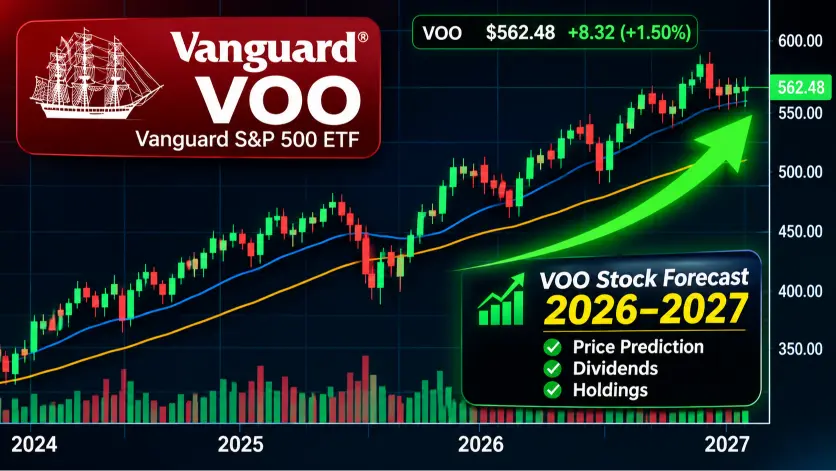
On November 23, 2026, VOO Stock was trading at approximately $665.93, according to a stock analysis market snapshot recorded at 11:22 a.m. EST. The reported gain was 4.78% compared with its previous close of $635.54. This was an intraday quote rather than the final closing price.
So, what could influence its performance in 2027? How much income does it distribute? Which companies have the greatest impact on its value? And is VOO Stock worth considering compared with SPY and IVV?
This guide examines the fund’s price, holdings, dividends, historical performance, investment costs and potential risks. It also explores possible market scenarios for 2027 to help readers understand what could affect its future performance.
VOO Stock: Key Facts at a Glance
| Fund detail | Information |
|---|---|
| Fund name | Vanguard S&P 500 ETF |
| Ticker symbol | VOO Stock |
| Fund provider | Vanguard |
| Primary exchange | NYSE Arca |
| Benchmark | S&P 500 Index |
| Inception date | September 7, 2010 |
| Expense ratio | 0.03% |
| Dividend schedule | Quarterly |
| Investment category | US large-cap equities |
| Management approach | Passive index tracking |
VOO Stock is designed to follow the performance of the S&P 500 Index. Vanguard uses a passive, full-replication strategy, meaning the fund aims to hold the securities in its benchmark in approximately corresponding proportions.
This approach gives investors access to a broad group of established US businesses without requiring them to purchase each company’s shares individually.
What Is VOO Stock and How Does It Work?
VOO Stock is an exchange-traded fund (ETF), not an individual company’s stock. It is managed by Vanguard and follows the S&P 500, an index representing major publicly traded US companies.
When investors purchase shares, they gain exposure to a portfolio containing businesses from different industries. These include technology companies, banks, healthcare providers, retailers and communication services businesses.
The fund uses market-capitalisation weighting. This means companies with larger market values generally receive higher portfolio weights. Consequently, a price movement in NVIDIA, Apple or Microsoft can have a greater effect on the fund than a similar movement in a smaller holding.
Vanguard launched the ETF on September 7, 2010. Its passive investment approach is designed to follow the benchmark rather than depend on a manager selecting individual stocks in an attempt to outperform the market.
One important point is that owning VOO Stock does not mean investing an equal amount in every company in the S&P 500. Its largest holdings represent a considerable share of the portfolio.
For investors, this creates a balance between broad company exposure and concentration in the largest businesses. Understanding both sides is important before making an investment decision.
VOO Stock Price Today: November 23, 2026
The fund traded at approximately $665.93 during the November 23 session, according to a StockAnalysis snapshot recorded at 11:22 a.m. EST. The reported increase was 4.78% compared with the previous close of $635.54.
Its reported 52-week trading range was $578.46 to $718.47.
| Price information | November 23 snapshot |
|---|---|
| Intraday price | $665.93 |
| Previous close | $635.54 |
| Reported daily change | +4.78% |
| 52-week low | $578.46 |
| 52-week high | $718.47 |
Important: These figures represent an intraday market snapshot, not the final closing price. ETF prices change throughout the trading session, so investors should check an updated quote before making decisions.
It is also useful to understand the difference between market price and net asset value (NAV). Market price is the amount at which ETF shares trade on an exchange. NAV represents the value of the fund’s underlying assets per share.
The two figures can differ slightly during trading because of supply, demand and market conditions.
For updated market information, visit StockAnalysis VOO data or Fidelity’s VOO Stock quote page.
VOO Stock Top Holdings: Which Companies Have the Biggest Influence?
Although the ETF holds hundreds of stocks, its largest positions have a greater influence on its overall performance.
According to Vanguard’s September 30, 2026 fact sheet, the following companies represented its ten largest holdings:
| Company | Portfolio weight |
|---|---|
| NVIDIA | 8.4% |
| Apple | 7.4% |
| Microsoft | 5.8% |
| Alphabet | 5.5% |
| Amazon | 3.7% |
| Broadcom | 2.5% |
| Meta Platforms | 2.4% |
| Micron Technology | 1.8% |
| Tesla | 1.5% |
| Advanced Micro Devices | 1.5% |
| Combined top-ten allocation | 40.6% |
Together, these ten positions represented approximately 40.6% of the fund’s total net assets on the reporting date.
This concentration is important because the performance of a relatively small group of major companies can significantly influence the overall portfolio. Strong results from these businesses may support the fund, while disappointing earnings or falling valuations could create pressure.
Investors should also remember that holdings change over time. The table reflects a historical reporting date rather than a live list of portfolio weights.
VOO Stock sector allocation
The sector breakdown provides another way to understand where the fund’s market exposure is concentrated.
Vanguard’s September 30, 2026, fact sheet reported that information technology accounted for 39.7% of the portfolio.
| Sector | Portfolio allocation |
|---|---|
| Information technology | 39.7% |
| Financials | 11.4% |
| Communication services | 9.9% |
| Healthcare | 9.3% |
| Consumer discretionary | 8.6% |
| Industrials | 8.0% |
| Consumer staples | 4.4% |
| Energy | 3.4% |
| Utilities | 1.9% |
| Materials | 1.7% |
| Real estate | 1.7% |
Why does sector allocation matter?
A large technology allocation can benefit the fund when major technology businesses report strong earnings and investor demand remains healthy. However, it can also increase exposure to declines when technology valuations fall or expectations for future growth weaken.
For example, disappointing earnings from several major technology companies could affect the index more significantly than weaker results from a smaller portfolio holding.
The sector figures are historical and can change as companies’ market values move and the index is rebalanced. Investors should consult Vanguard’s latest portfolio information before relying on these allocations.
VOO Stock Dividend: How Much Does It Pay?
VOO Stock generally distributes dividends four times a year. These payments come from dividends received from the companies held in the fund.
A November 23, 2026, VOO Stock analysis snapshot reported a trailing annual distribution of approximately $7.43 per share, with a distribution yield of around 1.12%.
These figures represent historical market data rather than a guaranteed future payment. Dividend amounts and yields can change over time.
The following distributions had been reported for 2026 by November 23:
| Ex-dividend date | Distribution per share |
|---|---|
| March 27, 2026 | $1.8724 |
| June 26, 2026 | $1.9622 |
| September 28, 2026 | $1.8226 |
The three payments listed above total $5.6572 per share. The reported trailing annual distribution of approximately $7.43 also includes the December 2025 distribution of $1.771, which explains the difference.
For example, an investor holding 100 shares on the relevant record date would receive $182.26 from a distribution of $1.8226 per share, before applicable taxes.
This calculation illustrates one historical payment. It should not be interpreted as a prediction of future quarterly income.
Is VOO Stock a good dividend investment?
VOO may appeal to investors who want dividend distributions alongside exposure to major US companies. However, it is generally better understood as a broad-market equity fund than as a high-income investment.
People whose primary goal is regular income may want to compare it with income-focused ETFs and other investments. They should consider distribution rates, operating expenses, investment risks and tax treatment.
The distribution yield can also change when the share price moves, even if the underlying payment remains unchanged.
VOO Stock Expense Ratio: Why the 0.03% Fee Matters
One of the fund’s main attractions is its reported expense ratio of 0.03%.
An expense ratio represents the annual operating cost of managing an investment fund, expressed as a percentage of its assets. The cost is reflected in the fund’s performance rather than normally being charged as a separate bill to each investor.
The following examples show what a 0.03% annual expense ratio represents at different investment values:
| Investment value | Approximate annual expense |
|---|---|
| $1,000 | $0.30 |
| $5,000 | $1.50 |
| $10,000 | $3.00 |
| $25,000 | $7.50 |
| $50,000 | $15.00 |
| $100,000 | $30.00 |
These are simplified illustrations based on the stated rate. Actual expenses depend on the investment’s value over time.
A low expense ratio can help reduce the cost of holding an ETF over many years. However, it does not eliminate losses caused by falling stock prices or guarantee better performance than other investments.
VOO Stock Historical Performance: What Has It Delivered?
Historical performance helps investors understand how a fund has behaved over different market periods. It can provide useful context when evaluating an investment, but it should not be treated as a prediction.
Vanguard’s September 30, 2026 fact sheet reported the following net asset value returns:
| Period | Return |
|---|---|
| Year to date | 12.72% |
| 1 year | 15.70% |
| 3 years, annualized | 22.85% |
| 5 years, annualized | 13.75% |
| 10 years, annualized | 15.29% |
| Since inception, annualized | 14.94% |
The year-to-date figure represents a cumulative return. The three-, five- and ten-year figures are annualized averages rather than total gains over those entire periods.
Vanguard’s reported performance assumes reinvestment of dividends and capital-gains distributions. The figures are net of fund expenses and before taxes.
The fact sheet also reported a 10-year NAV return of 15.29%, compared with 15.33% for the S&P 500 Index over the same measurement period. This shows how closely the ETF followed its benchmark during that period.
However, market conditions can change. Interest rates, corporate earnings, inflation and investor expectations may influence future returns differently from previous years.
Past performance does not guarantee future results.
VOO Stock vs. SPY vs. IVV: Which S&P 500 ETF Is Better?
VOO Stock is not the only ETF designed to track the S&P 500. The SPDR S&P 500 ETF Trust (SPY) and iShares Core S&P 500 ETF (IVV) provide similar exposure to large US companies.
| Feature | VOO | SPY | IVV |
|---|---|---|---|
| Provider | Vanguard | State Street | BlackRock |
| Benchmark | S&P 500 | S&P 500 | S&P 500 |
| Investment approach | Passive | Passive | Passive |
| Expense ratio | 0.03% | 0.0945% | 0.03% |
| Common use | Long-term investing | Trading and options | Long-term investing |
The expense ratios above are based on published 2026 disclosures. Investors should verify the latest figures using each provider’s official documents.
What is the practical difference?
VOO Stock: Its 0.03% expense ratio makes it a low-cost option for investors seeking long-term exposure to the S&P 500.
SPY: It is widely used by active traders and options market participants. Its trading activity and options market can be important advantages for people who trade frequently.
IVV: It also provides low-cost exposure to the S&P 500 and has a reported expense ratio of 0.03%.
For investors who simply want to follow the index over the long term, VOO Stock and IVV are both worth comparing. Those who frequently trade or use options may place greater importance on SPY’s trading characteristics.
There is no universal winner. The most appropriate choice depends on investment goals, brokerage arrangements, trading activity and total costs.
Source: 24/7 Wall St. – VOO vs. SPY vs. IVV comparison.
What Could a $1,000 Investment inVOO Stock Become?
Compounding can help investors understand how an investment might grow over time. The following example shows how a one-time $1,000 investment could change under three hypothetical annual return assumptions.
| Hypothetical annual return | After 1 year | After 3 years | After 5 years |
|---|---|---|---|
| 5% | $1,050 | $1,158 | $1,276 |
| 7% | $1,070 | $1,225 | $1,403 |
| 9% | $1,090 | $1,295 | $1,539 |
The calculations assume annual compounding, no additional contributions and no withdrawals. They are mathematical illustrations, not VOO price forecasts or guaranteed investment results.
The examples exclude taxes, inflation, brokerage costs and the effect of fund expenses. Actual stock-market returns are uneven, meaning an investment can rise in one year and decline in another.
The important lesson is that investment duration, financial goals and the ability to tolerate losses should all be considered before investing in an equity ETF.
Is VOO Stock a Good Investment in 2026?
VOO may be worth researching for investors seeking exposure to major US businesses through a single, relatively low-cost fund.
Its potential advantages include broad company exposure, a low operating expense ratio and a straightforward investment strategy. However, these features do not make it suitable for every investor.
Potential advantages
- Broad company exposure: Provides access to businesses across several major industries.
- Low operating cost: Its reported expense ratio is 0.03%.
- Quarterly distributions: Investors may receive dividends from the underlying companies.
- Simple investment strategy: Tracks the S&P 500 instead of relying on individual stock selection.
- Established history: Vanguard launched the ETF in 2010.
Important disadvantages and risks
- Market risk: Its value can decline when the S&P 500 falls.
- Large-company concentration: Its biggest holdings represent a significant portion of the portfolio.
- Technology exposure: Weakness among major technology businesses can influence overall performance.
- Limited international exposure: It focuses on large US companies rather than providing a complete global portfolio.
- Uncertain income: Dividend amounts and yields can change.
An investor saving for retirement over several decades may have different requirements from someone who needs their money within two or three years.
Before investing, consider your financial goals, emergency savings, existing portfolio, time horizon and ability to tolerate market declines.
VOO Stock Forecast 2027: What Could Influence Its Future?
VOO follows the S&P 500, so its future performance will largely depend on the companies in that index and the wider US economic environment.
Rather than assuming that previous returns will continue, investors should examine the factors that could support or weaken the market in 2027.
1. Corporate earnings growth
Company earnings are an important driver of stock-market valuations. If major US businesses continue reporting strong revenue and profit growth, investor confidence could improve.
On the other hand, weaker sales, rising operating costs or disappointing earnings guidance could put pressure on share prices.
Because VOO gives considerable weight to the largest companies, their financial results deserve particular attention.
2. Artificial intelligence and technology investment
Major technology companies have become an important part of the S&P 500. Their investment in artificial intelligence, cloud computing and data infrastructure could influence future earnings expectations.
Continued commercial growth could support some of the fund’s largest holdings. However, if AI-related spending does not produce the profits investors expect, valuations could come under pressure.
This is especially relevant because information technology represents a substantial share of the portfolio.
3. Federal Reserve interest-rate decisions
Interest rates influence borrowing costs, business investment and the attractiveness of different asset classes.
Lower interest rates may support stock valuations under certain economic conditions. However, the relationship is not automatic. If rates fall because the economy is weakening, corporate earnings may also come under pressure.
Investors should therefore monitor both Federal Reserve decisions and the economic conditions behind them.
4. Inflation and economic growth
Inflation affects household spending, business expenses and monetary policy. Persistent inflation could make it harder for companies to maintain profit margins.
Meanwhile, economic growth can support consumer demand and business investment. A weaker economy could create difficulties for companies across several industries.
5. Market valuations
Strong businesses do not always represent attractive investments at every price. If investors already expect exceptional earnings growth, even positive financial results may fail to satisfy market expectations.
Valuation levels are therefore important when considering the outlook for the S&P 500.
Bullish scenario for VOO in 2027
A positive scenario could develop if corporate earnings remain strong, inflation becomes more manageable and economic activity continues to expand.
In this environment, investor confidence could improve and major companies could support further market gains. Because the fund tracks the S&P 500, it would generally be expected to reflect the index’s movement, less expenses and tracking differences.
Bearish scenario for VOO in 2027
A weaker outcome could occur if earnings growth slows, inflation remains persistent, borrowing costs stay restrictive or major technology companies disappoint investors.
A decline in large-company valuations could put pressure on the S&P 500. The ETF would remain exposed to that broad-market weakness, despite holding hundreds of different stocks.
Neutral scenario for VOO in 2027
If corporate results and economic indicators remain mixed, the market could experience alternating gains and losses.
Investors may continue reassessing interest rates, company earnings and valuations without a clear direction emerging. In this situation, returns could be uneven rather than following a consistent upward or downward trend.
These scenarios describe possible market conditions. They are not guaranteed outcomes, precise price targets or personalized investment recommendations.
What Should Investors Check Before Buying VOO Stock?
Before purchasing shares, investors should evaluate more than the latest market price.
- Investment horizon: Money needed soon may not be suitable for an equity ETF that can experience substantial declines.
- Portfolio concentration: Review existing exposure to large US technology companies and other major S&P 500 holdings.
- Diversification: Owning several funds does not necessarily provide broader exposure if they contain many of the same companies.
- Dividend expectations: Distributions can change and should not be treated as guaranteed income.
- Total costs: Consider the expense ratio, brokerage charges, bid-ask spread and applicable taxes.
- Risk tolerance: Consider whether you could remain invested during a significant market decline.
- Fund information: Review Vanguard’s latest holdings, performance reports and prospectus before making a decision.
VOO can be one component of an investment portfolio, but it does not automatically replace international stocks, bonds, cash or other asset classes.
Frequently Asked Questions About VOO Stock
What is VOO stock?
VOO Stock is the ticker symbol for Vanguard S&P 500 ETF. It is an exchange-traded fund designed to track the S&P 500 Index and provide exposure to major US companies.
Is VOO a stock or an ETF?
VOO is an ETF, not an individual company’s stock. Buying its shares provides exposure to the underlying investment portfolio.
Does VOO pay dividends?
Yes. The fund generally distributes dividends four times a year. The payment amount and yield can change depending on distributions from its holdings and the market price.
What is VOO’s expense ratio in 2026?
Vanguard’s September 30, 2026 fact sheet reported an expense ratio of 0.03%. Investors should consult the latest fund documents for updated information.
Can VOO lose money?
Yes. Its value can decline when the S&P 500 falls. Holding hundreds of companies does not eliminate the risk of a broad stock-market downturn.
Is VOO good for beginners?
It may be easier to understand than selecting individual companies because it provides exposure to many large US businesses through one investment. Beginners should still understand market risk, fees, diversification and their investment time horizon.
Is VOO better than SPY?
Neither fund is automatically better for every investor.VOO Stock has a lower reported expense ratio, while SPY is widely used by traders who value its trading activity and options market. The choice depends on individual investment needs.
How often does VOO pay dividends?
VOO generally distributes dividends quarterly, or four times a year. Payment dates and amounts can change.
What are VOO’s largest holdings?
Vanguard’s September 30, 2026 fact sheet listed NVIDIA, Apple, Microsoft, Alphabet and Amazon among its largest positions. Portfolio weights can change over time.
What is the VOO stock forecast for 2027?
Its performance will depend on factors such as S&P 500 earnings, interest rates, technology valuations, inflation and economic growth. These factors can help investors understand possible outcomes, but they cannot establish a guaranteed price target.
Is VOO diversified?
It provides exposure to hundreds of large US companies across multiple sectors. However, it is concentrated in the US large-cap market and gives considerable weight to its biggest holdings. It does not provide complete global or asset-class diversification.
Can I invest in VOO for the short term?
Shares can be bought and sold during market hours, but their value can fall significantly. Investors who need their money soon should consider whether they could tolerate a loss when they need to sell.
Final Thoughts: Is VOO Worth Watching in 2027?
VOO remains an established option for investors researching low-cost exposure to major US companies. Its 0.03% expense ratio, quarterly dividend distributions and S&P 500 tracking strategy make it an important fund to understand when comparing broad-market investments.
However, its large-company concentration and substantial technology exposure mean that its performance can be influenced by a relatively small group of businesses. A broad portfolio does not eliminate the possibility of losses during a market downturn.
For 2027, corporate earnings, interest rates, inflation, AI-related investment and market valuations will be important factors to monitor. Rather than relying on a single price prediction, investors should consider how different economic conditions could affect the fund.
The key takeaway: VOO may be worth researching as part of a long-term investment strategy, but its suitability depends on individual financial goals, risk tolerance and investment horizon. Future returns are never guaranteed.
This article is for informational and educational purposes only. It is not personalized financial, tax or investment advice. Investments can lose value, and past performance does not guarantee future results.
Explore more new current latest worldwild newes
Disney Discontinues Hulu Standalone App