
Petrol Price in Pakistan Today – Latest Rate and Fuel Cost Guide
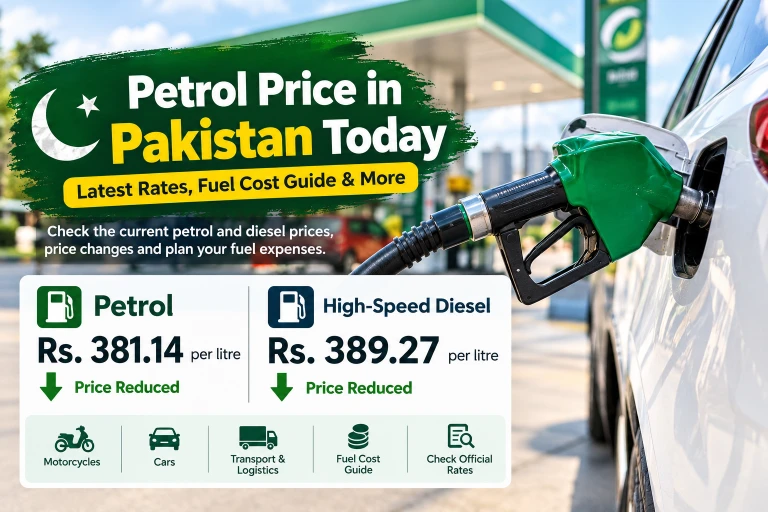
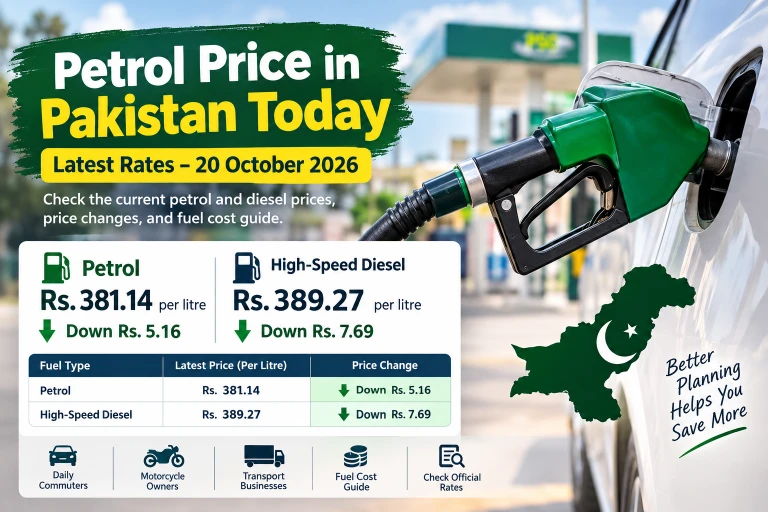
The petrol price in Pakistan today is Rs. 381.14 per litre, effective from 20 October 2026. The government has reduced the petrol price by Rs. 5.16 per litre. High-speed diesel now costs Rs. 389.27 per litre after a reduction of Rs. 7.69.
These new rates matter to everyone who travels by motorcycle, car, rickshaw, or other petrol-powered vehicle. Even a small change in the price can affect your daily travel budget, especially if you commute to work or school.
In this guide, you will find the latest petrol price in Pakistan, current diesel rates, the cost of buying different amounts of petrol, and the main reasons fuel prices change. You will also learn how to check the latest official rates and manage your fuel expenses.
What Is the Petrol Price in Pakistan Today?
The petrol price in Pakistan today is Rs. 381.14 per litre. The revised rate took effect on 20 October 2026, following the latest government announcement. The previous petrol price was Rs. 386.30 per litre.
The government reduced the price by Rs. 5.16 per litre. This means drivers now pay slightly less for the same amount of petrol than they did under the previous rate. However, the actual saving depends on how much fuel they purchase.
Here is a quick overview of the latest prices.
| Fuel Type | Latest Price Per Litre | Price Change |
|---|---|---|
| Petrol | Rs. 381.14 | Down Rs. 5.16 |
| High-speed diesel | Rs. 389.27 | Down Rs. 7.69 |
These rates are based on the latest reported Petroleum Division notification for 20 October 2026. Dawn reported the revised prices and their effective date.
Petrol is commonly used in motorcycles, private cars, and many rickshaws. High-speed diesel is widely used in buses, trucks, agricultural machinery, and other diesel-powered vehicles.
Important: Fuel prices can change under the current pricing system. Check the latest notification before relying on these figures on another date.
How Much Does Petrol Cost for 1, 5, 10, and 20 Litres?
Knowing the petrol price per litre helps, but most people also want to know how much they will pay at the petrol pump.
At the current rate of Rs. 381.14 per litre, you can estimate your fuel cost using a simple calculation.
Fuel cost = Number of litres × Price per litre
The following table shows the cost of different quantities of petrol at today’s rate.
| Petrol Quantity | Total Cost |
|---|---|
| 1 litre | Rs. 381.14 |
| 2 litres | Rs. 762.28 |
| 3 litres | Rs. 1,143.42 |
| 5 litres | Rs. 1,905.70 |
| 10 litres | Rs. 3,811.40 |
| 15 litres | Rs. 5,717.10 |
| 20 litres | Rs. 7,622.80 |
| 30 litres | Rs. 11,434.20 |
| 40 litres | Rs. 15,245.60 |
| 50 litres | Rs. 19,057.00 |
These figures are calculated from the current published rate. They do not represent separate prices charged by petrol stations.
For example, if you purchase 5 litres of petrol, the estimated cost is Rs. 1,905.70. If you buy 10 litres, the cost increases to Rs. 3,811.40.
This calculation is useful when planning a monthly transport budget. You can estimate your expected spending before visiting a petrol station.
Remember that these totals will change whenever the official petrol price changes.
What Was the Previous Petrol Price in Pakistan?
Before the latest reduction, petrol cost Rs. 386.30 per litre. The new rate of Rs. 381.14 means motorists now pay Rs. 5.16 less for every litre purchased.
The difference may look small when buying one litre. However, the saving becomes more noticeable when purchasing larger quantities.
For example, buying 10 litres at the previous price would have cost Rs. 3,863. At the current price, the same quantity costs Rs. 3,811.40.
That is a saving of Rs. 51.60 on 10 litres.
Here is the comparison:
| Petrol Quantity | Previous Cost | Current Cost | Saving |
|---|---|---|---|
| 1 litre | Rs. 386.30 | Rs. 381.14 | Rs. 5.16 |
| 5 litres | Rs. 1,931.50 | Rs. 1,905.70 | Rs. 25.80 |
| 10 litres | Rs. 3,863.00 | Rs. 3,811.40 | Rs. 51.60 |
| 20 litres | Rs. 7,726.00 | Rs. 7,622.80 | Rs. 103.20 |
| 50 litres | Rs. 19,315.00 | Rs. 19,057.00 | Rs. 258.00 |
The key point is simple: a small reduction per litre can produce a meaningful saving when you purchase fuel regularly.
However, the benefit depends on how much petrol you use. Someone who buys a few litres occasionally will save less than someone who regularly purchases larger amounts.
Why Does the Petrol Price Change in Pakistan?
Petrol prices in Pakistan depend on several factors. International oil prices, the exchange rate, transportation costs, and government taxes can all affect the amount consumers pay.
Pakistan imports a significant share of its petroleum requirements. Changes in international markets can therefore influence domestic fuel prices.
Here are the main factors behind petrol price changes.
1. International Oil Prices
Crude oil prices can rise or fall because of changes in global demand, supply, and political conditions.
For example, conflict in an oil-producing region can create concerns about supply. When traders expect shortages, international oil prices may increase.
When supply improves or demand weakens, prices may move in the opposite direction. These changes can affect the cost of importing fuel into Pakistan.
However, a fall in international oil prices does not always produce an immediate or equal reduction at local petrol pumps.
2. The Pakistani Rupee and US Dollar
International petroleum purchases are closely linked to the US dollar.
If the Pakistani rupee loses value against the dollar, importing the same quantity of oil can become more expensive in rupee terms.
On the other hand, a stronger rupee can help reduce import costs, assuming other factors remain similar.
This is one reason why international oil prices alone cannot tell you exactly what the next petrol price in Pakistan will be.
3. Government Taxes and Levies
Government taxes and petroleum levies are also important parts of the retail price.
According to Dawn’s report on the 20 October revision, the government was charging Rs. 114 per litre in taxes and duties on petrol and Rs. 100 per litre on high-speed diesel.
These figures were reported alongside the latest price announcement. They should not be treated as a permanent breakdown because tax policies and fuel-price components can change.
4. Shipping and Other Costs
Petroleum must be transported, stored, and distributed before it reaches a petrol pump.
Import costs, freight charges, exchange-rate adjustments, and local distribution expenses can influence the final price.
The government and relevant regulators consider applicable pricing components when determining fuel rates.
For this reason, the petrol price in Pakistan reflects more than the international price of crude oil.
How Often Does the Petrol Price Change in Pakistan?
Pakistan introduced a daily fuel-price review mechanism in July 2026 amid volatility in international petroleum markets.
Under this system, fuel prices can change from day to day rather than following the previous fixed fortnightly schedule. The exact effective rate depends on the latest official notification.
The new system means motorists should be careful when reading older articles. A page showing yesterday’s petrol price may no longer contain the latest figure.
For example, the price announced for 20 October 2026 is Rs. 381.14 per litre. An article showing the previous price of Rs. 386.30 is outdated for this date.
To avoid confusion, check three things when reading a fuel-price update:
- The publication date: When was the information posted?
- The effective date: When does the new rate apply?
- The official notification: Does the reported price match the latest announcement?
These details are particularly important when prices change frequently.
How Can You Check the Latest Petrol Price in Pakistan?
The easiest way to confirm the current petrol price is to check an official government or regulatory source.
The Oil and Gas Regulatory Authority (OGRA) publishes petroleum-price notifications through its fuel-pricing portal. The Petroleum Division also publishes fuel-price announcements.
You can follow these steps:
- Visit the official OGRA fuel-pricing portal.
- Look for the latest daily fuel-price notification.
- Open the relevant notification and check its date.
- Find the petrol rate per litre.
- Compare it with the date and rate shown in any news report you read.
You can also check the Petroleum Division’s latest news page for government announcements.
News websites can help you understand what changed and why. However, the official notification is the better place to confirm the applicable rate.
A useful tip: If you run a website covering petrol prices, update the displayed price and its effective date together. Changing the number without updating the date can confuse readers.
How Does the Petrol Price Affect Daily Expenses?
Petrol is an important part of the monthly budget for many Pakistani households. Its cost affects not only people who drive cars but also motorcycle owners, commuters, businesses, and transport operators.
The direct effect depends on how much fuel a person uses. The indirect effect can be wider because fuel is also used to move goods and people.
Motorcycle Owners
Motorcycles are a common choice for daily travel. Many people use them to reach workplaces, educational institutions, shops, and other destinations.
When petrol prices increase, regular riders may need to spend more on commuting. When prices fall, they can save money if their fuel use remains similar.
The actual monthly impact depends on distance travelled, traffic conditions, motorcycle efficiency, and maintenance.
Car Owners
Cars generally consume more fuel than motorcycles, although consumption varies by vehicle and driving conditions.
A person who travels long distances every day may notice a larger change in fuel spending than someone who drives only occasionally.
Planning journeys, avoiding unnecessary trips, and keeping the vehicle properly maintained can help manage expenses.
Transport and Delivery Businesses
Transport companies, delivery services, and other businesses may use petrol or diesel as part of their operating costs.
Changes in fuel prices can affect delivery expenses and transport budgets. Businesses may respond by improving routes, reducing unnecessary trips, or adjusting their pricing.
Diesel is especially important for heavy transport, including trucks and buses. Its price can influence the cost of moving goods across the country.
However, fuel is only one factor in transport costs. Labour, vehicle maintenance, tolls, and other expenses also matter.
How Can You Save Petrol Without Changing Your Daily Routine Too Much?
You cannot control the official petrol price, but you can take practical steps to reduce unnecessary fuel use.
The best approach is to improve how you use your vehicle rather than making unrealistic promises about fuel savings.
Avoid Unnecessary Trips
Combine errands when possible. For example, if you need to visit a shop and a bank in the same area, completing both trips together may save time and fuel.
Planning your route before leaving can also help you avoid unnecessary distance.
Keep Your Tyres Properly Inflated
Incorrect tyre pressure can affect fuel efficiency and vehicle handling.
Check your tyre pressure according to the vehicle manufacturer’s recommendations. Do not assume that every vehicle needs the same pressure.
Regular checks also help you identify tyre problems before they become more expensive.
Maintain Your Vehicle
Follow the recommended maintenance schedule for your car or motorcycle.
Clean air filters, suitable engine oil, correctly maintained tyres, and timely servicing can help keep a vehicle running properly.
Maintenance requirements vary by vehicle, so follow the manufacturer’s guidance rather than replacing parts unnecessarily.
Drive Smoothly
Frequent hard acceleration and sudden braking can waste fuel.
Where road conditions permit, accelerate smoothly and maintain a steady speed. Avoid unnecessary idling when it is safe and practical to switch the engine off.
Always prioritise road safety. Saving a small amount of petrol is never worth taking a driving risk.
Track Your Fuel Spending
Keep a simple record of how much petrol you buy and how far you travel.
For example, note your odometer reading when you fill the tank and check it again at the next fill-up. Over time, this can help you understand your vehicle’s actual fuel consumption.
It is more useful to measure your own results than to rely on a fuel-efficiency figure that may not match your driving conditions.
Will Petrol Prices Increase or Decrease in Pakistan?
No one can reliably predict the next petrol price using a single factor.
International crude oil prices, the rupee-dollar exchange rate, import expenses, government taxes, and the official pricing mechanism can all influence the final rate.
If international oil prices fall and other costs remain stable, Pakistan may have room for a reduction. If import costs or other pricing components rise, petrol prices may increase instead.
The latest reduction of Rs. 5.16 per litre is a confirmed change for 20 October 2026. It does not guarantee that prices will continue falling.
The most practical approach is to follow official notifications instead of relying on social media predictions or unconfirmed reports.
For household budgeting, it is also sensible to allow some room for changes in fuel expenses rather than assuming today’s price will remain unchanged for the rest of the month.
Frequently Asked Questions About Petrol Price in Pakistan
1. What is the petrol price in Pakistan today?
The petrol price in Pakistan today is Rs. 381.14 per litre, effective from 20 October 2026. The government reduced the previous rate by Rs. 5.16 per litre.
2. What is the diesel price in Pakistan today?
High-speed diesel costs Rs. 389.27 per litre from 20 October 2026. This is Rs. 7.69 lower than the previous rate of Rs. 396.96 per litre.
3. What is the cost of 5 litres of petrol in Pakistan?
At Rs. 381.14 per litre, 5 litres of petrol cost Rs. 1,905.70. The total is calculated by multiplying the per-litre rate by five.
4. What is the cost of 10 litres of petrol today?
Ten litres of petrol cost Rs. 3,811.40 at the current rate of Rs. 381.14 per litre. This amount may change when a new rate takes effect.
5. Is the petrol price the same across Pakistan?
The officially notified petrol rate generally applies nationwide. However, transport expenses and other local factors may affect the overall cost of getting fuel to different areas. Check the latest official notification for the applicable rate.
6. Why does the petrol price change so often?
Pakistan introduced a daily fuel-price review mechanism in July 2026. Changes in international petroleum markets and other pricing components can lead to frequent revisions.
7. Where can I check the official petrol price?
You can check the OGRA fuel-pricing portal and the Petroleum Division’s latest announcements. Always confirm the notification date and effective date before using a reported rate.
8. Does a lower petrol price reduce transport fares immediately?
Not necessarily. Fuel is only one part of transport costs. Operators may also consider wages, maintenance, tolls, route expenses, and other operating costs when setting fares.
9. How can I calculate my petrol expenses?
Multiply the number of litres you purchase by the current price per litre. For example, 15 litres at Rs. 381.14 cost Rs. 5,717.10.
10. Will petrol become cheaper in the coming days?
There is no guaranteed answer. Future prices depend on international oil markets, exchange rates, government decisions, and the applicable pricing mechanism. Check the latest official announcement for a confirmed rate.
Conclusion
The petrol price in Pakistan today is Rs. 381.14 per litre, effective from 20 October 2026. High-speed diesel costs Rs. 389.27 per litre after the latest reduction.
The petrol rate has fallen by Rs. 5.16 per litre, which offers some relief to motorists. The amount each person saves depends on their fuel consumption and travel habits.
For the most accurate information, check the latest OGRA or Petroleum Division notification before relying on a petrol-price update. Since fuel rates can change frequently, always confirm the effective date.
Keeping track of your fuel spending, maintaining your vehicle, and planning trips carefully can also help you manage transport costs.
What do you think about the latest petrol price in Pakistan? Has the recent reduction made a noticeable difference to your travel budget?