
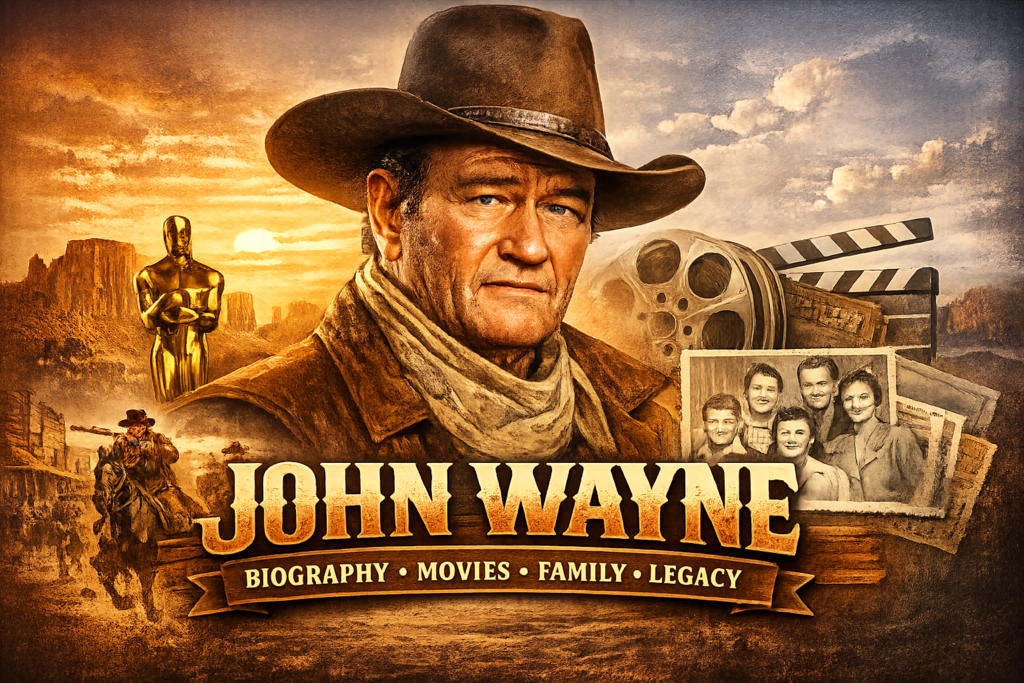
John Wayne: Biography, Movies, Family, and Hollywood Legacy
John Wayne remains one of the most recognizable stars in American film history. Known to fans as The Duke, he became famous for his deep voice, confident screen presence, and memorable portrayals of cowboys, lawmen, soldiers, and other determined characters. His performances helped shape the image of the classic Hollywood Western hero.
However, John Wayne’s life extended beyond the fearless characters he played on screen. Before becoming a major star, he worked behind the scenes in Hollywood and appeared in smaller film roles. His career changed significantly after Stagecoach (1939), and he went on to work as an actor, producer, and director for several decades.
In 1970, Wayne won the Academy Award for Best Actor for his performance in True Grit (1969). His family life, political views, experience with cancer, and influence on American popular culture also became important parts of his story.
Understanding John Wayne means examining both his achievements and the controversies surrounding his legacy. His films remain significant examples of classic Hollywood cinema, while modern audiences continue to discuss the historical attitudes and values represented in some of his work.
For more up-to-date current affairs in the world. How tall is Tom Welling
Who Was John Wayne?
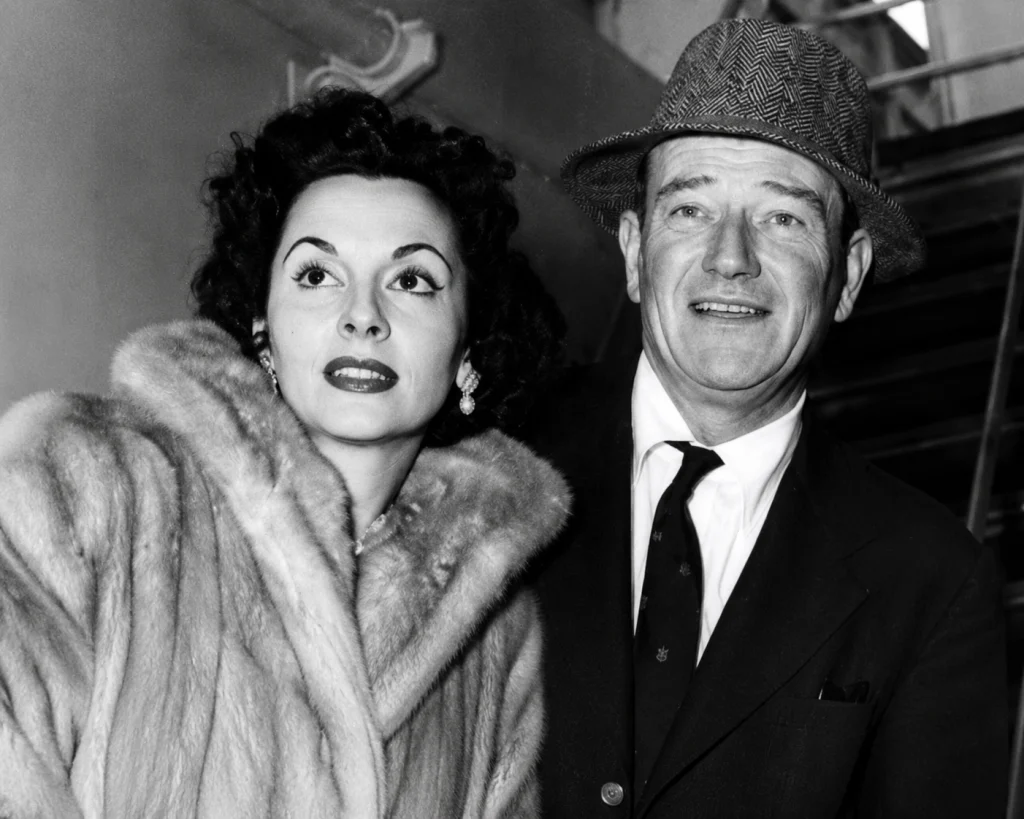
John Wayne was an American actor, producer, and director best known for Western films. He became one of Hollywood’s leading stars during the twentieth century and helped establish a recognizable style of Western storytelling.
Here are the essential facts about his life and career.
| Detail | Information |
|---|---|
| Birth name | Marion Robert Morrison |
| Professional name | John Wayne |
| Nickname | The Duke |
| Date of birth | May 26, 1907 |
| Birthplace | Winterset, Iowa, United States |
| Profession | Actor, producer, director |
| Breakthrough film | Stagecoach (1939) |
| Oscar-winning film | True Grit (1969) |
| Academy Award | Best Actor, presented in 1970 |
| Children | Seven |
| Date of death | June 11, 1979 |
| Age at death | 72 |
| Final feature film | The Shootist (1976) |
Wayne’s influence came from more than his popularity. His performances helped establish a familiar image of the Western hero, while some of his strongest roles challenged the assumption that a leading character must always be admirable or morally right.
John Wayne’s Early Life and Education
John Wayne was born Marion Robert Morrison on May 26, 1907, in Winterset, Iowa. His parents were Clyde Leonard Morrison and Mary “Molly” Brown Morrison. His family later moved to California, where he spent much of his childhood and teenage years.
Wayne developed an interest in sports, especially football. He attended the University of Southern California on a football scholarship, but an injury affected his athletic ambitions and interrupted his university career.
His entry into filmmaking was gradual. He found work around Hollywood productions, including practical jobs and appearances as an extra. These early experiences introduced him to film production and helped him develop connections within the industry.
One important connection was director John Ford, who later directed Wayne in several influential films. During the late 1920s, Wayne continued taking small roles and learning about acting and filmmaking.
His rise to fame was not immediate. Years of work in smaller productions helped prepare him for the opportunity that eventually changed his career.
How Marion Morrison Became John Wayne
John Wayne was a professional name rather than the name he received at birth.
Director Raoul Walsh selected Wayne for the leading role in The Big Trail, released in 1930. During the production, he began using the name John Wayne, which he kept throughout his acting career.
Although The Big Trail offered him an important opportunity, it did not immediately turn him into a major star. Wayne continued appearing in lower-budget productions and Westerns while developing his acting style.
His nickname, The Duke, has a different origin. The California Museum’s biography connects it to an Airedale terrier named Duke that was associated with Wayne during his childhood.
Over time, the nickname became closely linked to his public image. It suited the confident and independent characters he often portrayed, although his career involved many different types of roles.
How Stagecoach Made John Wayne a Star
John Wayne’s career changed significantly in 1939 when he appeared in Stagecoach, directed by John Ford.
The film follows a group of passengers traveling through dangerous territory in the American West. Wayne played the Ringo Kid, an outlaw whose journey brings him into contact with people from different backgrounds.
His performance helped establish him as a leading Hollywood actor and strengthened his professional relationship with Ford. The film combined action, suspense, character development, and social tension, making it an important work in Western cinema.
Wayne’s screen presence helped him stand out, but the film’s success also depended on its ensemble cast and Ford’s direction.
After Stagecoach, Wayne continued building his career through Westerns, military dramas, historical adventures, and other genres. His recognizable acting style became an important part of his appeal to audiences.
Seven John Wayne Movies Worth Watching
John Wayne appeared in more than 175 films, according to the California Museum’s biographical material. The following seven movies provide a useful introduction to his career and most memorable screen roles.
1. Stagecoach (1939)
Stagecoach helped establish Wayne as a leading Hollywood star. He played the Ringo Kid, a wanted man traveling with a group of passengers through dangerous Western territory.
The film explores social differences, personal relationships, courage, and survival. Its combination of action and character-driven storytelling helped make it an important Western.
Why watch it: It is an excellent starting point for understanding Wayne’s rise to fame and his collaboration with John Ford.
2. Red River (1948)
In Red River, Wayne plays Thomas Dunson, a determined rancher who leads a difficult cattle drive. His ambition creates conflict with Matt Garth, his adopted son, played by Montgomery Clift.
Dunson’s determination helps him survive challenging circumstances, but his controlling behavior threatens the people around him. The story explores authority, pride, generational conflict, and the consequences of refusing to compromise.
Why watch it: The film shows Wayne portraying a powerful character whose strengths also become serious weaknesses.
3. The Searchers (1956)
Directed by John Ford, The Searchers follows Ethan Edwards, a former Confederate soldier searching for his kidnapped niece.
As the journey continues, Ethan’s prejudice, anger, and desire for revenge become central to the story. Rather than presenting him as a straightforward hero, the film encourages viewers to examine the troubling aspects of his character.
The movie has attracted extensive critical discussion because of its treatment of race, violence, obsession, and the myths associated with the American frontier. The Library of Congress includes The Searchers in the National Film Registry, recognizing its significance in American film history.
Why watch it: It offers a more complicated view of the Western hero than many traditional adventure films.
4. Rio Bravo (1959)
In Rio Bravo, Wayne plays Sheriff John T. Chance, who attempts to protect a prisoner while facing pressure from a powerful local rancher.
The film also features Dean Martin, Ricky Nelson, and Angie Dickinson. Its story combines suspense, humor, and relationships between people who must depend on one another during a dangerous situation.
Chance’s authority comes from experience, judgment, and determination rather than constant aggression.
Why watch it: It is an accessible introduction to the classic Western style associated with Wayne.
5. The Alamo (1960)
The Alamo presents a dramatized account of the 1836 Battle of the Alamo during the Texas Revolution. Wayne played Davy Crockett and also served as the film’s director and producer.
The production was ambitious and demonstrated his interest in historical stories and large-scale filmmaking. It also showed that his professional interests extended beyond acting.
The film received seven Academy Award nominations, including Best Picture, at the 1961 Academy Awards.
Why watch it: It reveals Wayne’s ambitions as a filmmaker and his interest in stories associated with American history.
6. True Grit (1969)
True Grit gave Wayne the only competitive acting Academy Award of his career. He played Rooster Cogburn, a tough and unconventional U.S. marshal who helps a young girl pursue her father’s killer.
Cogburn is experienced and determined, but his rough manners and unpredictable behavior distinguish him from a conventional lawman. Wayne combined his familiar screen toughness with humor and a more relaxed approach to the character.
At the 1970 Academy Awards, Wayne won Best Actor for this performance.
Why watch it: It is essential viewing for anyone interested in Wayne’s acting achievements and his most famous award-winning role.
7. The Shootist (1976)
The Shootist was Wayne’s final feature film. He played J. B. Books, an aging gunfighter who discovers that he has a terminal illness.
Rather than relying entirely on action, the film explores mortality, reputation, loneliness, and the difficulty of accepting change. Books must consider how he wants to spend his remaining time and how others will remember him.
The role carries additional significance because Wayne had experienced cancer himself. However, Books is a fictional character, and the film should not be treated as a literal account of Wayne’s medical history.
Why watch it: It provides a reflective conclusion to a career largely associated with strong, independent characters.
What Made John Wayne’s Acting Style Distinctive?
Wayne developed a screen persona that audiences could recognize almost immediately. His deep voice, measured delivery, physical confidence, and deliberate movements helped make his characters seem experienced and difficult to intimidate.
He also understood the value of restraint. Instead of explaining every emotion through dialogue, he could communicate irritation, confidence, or uncertainty through a look, a pause, or a short response.
Several qualities helped distinguish his performances:
- Distinctive voice: His delivery made even brief lines memorable.
- Physical presence: His posture and movements helped establish authority.
- Dry humor: Understated jokes added personality to serious scenes.
- Clear character values: Many roles emphasized loyalty, responsibility, or personal principles.
- Complex characters: In films such as The Searchers, he portrayed people whose actions and beliefs could be morally troubling.
Although Wayne often played characters with similar strengths, his best films revealed different sides of his screen persona.
John Wayne’s Awards and Achievements
Wayne’s most famous acting achievement was his Academy Award for Best Actor for True Grit. The award was presented at the 42nd Academy Awards on April 7, 1970, honoring films released in 1969.
His career extended beyond acting. He produced films, directed The Alamo, supported military-related causes, and became one of the best-known figures in American popular culture.
His notable achievements include:
- Winning the Academy Award for Best Actor for True Grit.
- Directing and producing The Alamo.
- Receiving the Congressional Gold Medal, authorized in 1979 and presented to his family in 1980.
- Receiving the Presidential Medal of Freedom posthumously in 1980.
- Becoming an enduring figure in classic Western cinema.
These honors reflect Wayne’s cultural influence, but they do not place every aspect of his work or public life beyond criticism. A balanced account considers his filmmaking achievements alongside the historical and political questions associated with his career.
John Wayne’s Family and Personal Life
Wayne married three times and had seven children: Michael, Toni, Patrick, Melinda, Aissa, Ethan, and Marisa.
Although the public primarily knew him through his films, family remained an important part of his personal life. Several family members later became involved in preserving his memory and supporting causes associated with his name.
In 1985, his children established the John Wayne Cancer Foundation. The organization was created to continue efforts related to cancer awareness, research, education, and support.
His birthplace is commemorated by the John Wayne Birthplace & Museum in Winterset, Iowa. The museum preserves material connected with his early life and career.
Wayne’s family legacy is therefore linked not only to his films but also to organizations and initiatives established in his memory.
John Wayne’s Illness and Death
In 1964, Wayne was diagnosed with lung cancer and underwent surgery that included the removal of a lung. He later returned to acting and continued working in demanding productions.
Wayne spoke publicly about his illness and encouraged people to take medical checkups seriously. His experience became an important part of his public story.
In January 1979, cancer was discovered during an operation. Historical accounts describe the disease as involving his stomach and gastric lymph nodes. Wayne died in Los Angeles on June 11, 1979, at the age of 72.
His death marked the end of a career that had lasted for decades, but his films continued reaching new generations of viewers. His family’s cancer foundation also helped preserve a connection between his personal experience and later cancer-related initiatives.
Why John Wayne’s Legacy Remains Complicated
John Wayne remains an important figure in film history because his performances helped define the popular image of the Western hero. His movies continue to attract viewers interested in classic Hollywood, character-driven storytelling, and the development of the Western genre.
However, his legacy is not viewed in the same way by everyone. Some audiences admire the courage, loyalty, and determination associated with his characters. Others examine his political statements, racial attitudes, and the stereotypes or historical assumptions present in some of his films.
These perspectives can coexist in a serious discussion of his career. A film can be influential and artistically significant while still containing ideas that modern audiences question or reject.
For new viewers, watching films from different periods provides a fuller understanding of Wayne’s work. Stagecoach illustrates his breakthrough, The Searchers offers a challenging character study, True Grit showcases his award-winning performance, and The Shootist reflects on aging and mortality.
Together, these films demonstrate why John Wayne became a major Hollywood star and why his career continues to generate discussion.
Frequently Asked Questions About John Wayne
What was John Wayne’s real name?
John Wayne was born Marion Robert Morrison. He began using the professional name John Wayne during the production of The Big Trail in 1930.
When was John Wayne born?
He was born on May 26, 1907, in Winterset, Iowa, United States.
How old was John Wayne when he died?
Wayne was 72 years old when he died on June 11, 1979.
What was John Wayne’s most famous movie?
His best-known films include Stagecoach, The Searchers, Rio Bravo, True Grit, and The Shootist. The answer depends on whether the focus is popularity, critical reputation, or his most celebrated acting performance.
Did John Wayne win an Oscar?
Yes. He won the Academy Award for Best Actor for playing Rooster Cogburn in True Grit. The award was presented in 1970.
How many children did John Wayne have?
He had seven children: Michael, Toni, Patrick, Melinda, Aissa, Ethan, and Marisa.
What was John Wayne’s last movie?
His final feature film was The Shootist, released in 1976.
Why was John Wayne called The Duke?
The nickname is associated with an Airedale terrier named Duke that was connected with him during his childhood. It later became a familiar part of his public identity.
What caused John Wayne’s death?
Wayne died from cancer on June 11, 1979. He had undergone surgery for lung cancer in 1964 and later developed cancer involving his stomach and gastric lymph nodes.
Conclusion
John Wayne’s career helped shape how generations of audiences understood the American Western. From his breakthrough in Stagecoach to his Oscar-winning performance in True Grit and his final role in The Shootist, he left a body of work that remains an important part of classic Hollywood history.
His legacy includes memorable performances, filmmaking achievements, family initiatives, and ongoing debate about the values associated with his public image. Considering both his accomplishments and the controversies surrounding his career offers a fuller understanding of the man behind the famous nickname, The Duke.