
Delhi AQI Remains in ‘Very Poor’ Category as Diwali Celebrations Intensify
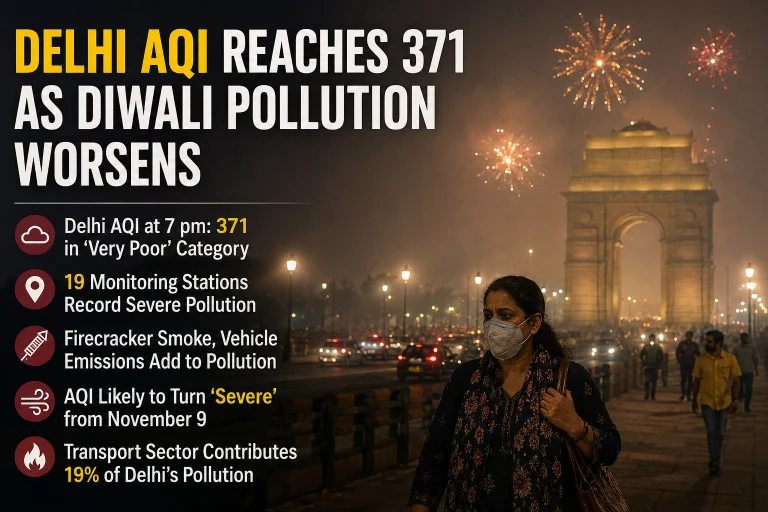
Delhi’s AQI crossed 371 at 7 pm on Sunday as Diwali celebrations led to a spike in air pollution in the national capital. Smoke and haze were seen across the city as air pollution from firecrackers increased. Several residents have also complained about the smell of smoke.
The latest AQI reading showed that the air quality in Delhi is now classed as very poor and nearing severe levels. Many residents are also complaining about decreased visibility during the celebrations.
Delhi AQI at 7 PM: 19 Monitoring Stations Record Severe Pollution
According to data from 59 air quality monitoring stations, 19 locations recorded ‘severe’ pollution levels by 7 pm. Another 33 stations reported ‘very poor’ conditions, while seven recorded ‘poor’ air quality.
Jahangirpuri recorded the highest Delhi AQI at 460, making it the worst-affected monitoring location.
CPCB Air Quality Categories Explained
The Central Pollution Control Board (CPCB) classifies AQI levels into six categories:
- Good: 0–50
- Satisfactory: 51–100
- Moderate: 101–200
- Poor: 201–300
- Very Poor: 301–400
- Severe: 401–500
Delhi’s average AQI settled at 376 on Sunday, compared with 369 on Saturday, showing a further deterioration in the city’s air quality.
Delhi Residents Report Smoke and Hazy Conditions During Diwali
Several citizens took to social media platform X to complain about the stench of firecrackers and smoke in various areas of Delhi.
Some of them also said there was poor visibility due to the ongoing Diwali festivities. AQI levels in Delhi are currently high.
Delhi AQI Forecast: Pollution May Enter Severe Category on November 9
The Air Quality Early Warning System (EWS) has predicted that Delhi’s Air Quality could worsen to severe levels from November 9 and continue to do so for next few days.
This is expected as multiple factors such as fire crackers, vehicles and crop residue burning will contribute to worsening air quality in Delhi.
Firecracker Emissions and Vehicular Pollution Add to Delhi AQI
Moreover, the firecracker smoke is putting more particulate matter into the air which is already polluted. Vehicle emissions and stubble burning will also contribute to an increase in pollution.
Furthermore, bad weather can cause the pollution not to be dispersed properly causing higher levels of danger in the Delhi AQI.
Unfavourable Weather Conditions Could Worsen Delhi AQI
EWS said if the ventilation index is less than 6,000 square metres per second and the mean wind speed is less than 10 km/h, the atmospheric conditions will become unfavourable for pollutant dispersion.
This could result in a build-up of pollutants in the atmosphere, worsening air quality in Delhi.
PM2.5 Remains the Main Pollutant Affecting Delhi Air Quality
PM 2.5 has been found to be the main pollutant in Delhi. Firecrackers have caused the levels of fine particulate pollution to increase.
This is a concern as PM2.5 is present when Delhi’s AQI remains at ‘very poor’ levels during the Diwali period.
Transport Sector Accounts for 19% of Delhi Pollution
According to the Decision Support System (DSS) for Delhi, the transport sector was expected to become the largest contributor to the city’s pollution on Sunday, accounting for approximately 19% of the overall pollution load.
Stubble Burning Contribution Estimated at 3.5%
Stubble burning was estimated to contribute 3.5% of Delhi’s pollution on Sunday. Its projected contribution was expected to decline slightly to approximately 2.99% on Monday.
Along with firecracker emissions and vehicular pollution, agricultural burning remains another factor affecting Delhi AQI.
Delhi AQI Outlook: Air Pollution Concerns Continue After Diwali
Delhi is facing an air quality problem due to various pollution sources. Firecrackers, vehicular pollution and stubble burning will further impact the air quality of the national capital.
With the EWS predicting that Delhi may move into the ‘severe’ category from November 9, the AQI could worsen further in the coming days.