
Cruise Ship Overboard: Rescue, Survival and Safety Guide
A cruise ship overboard incident happens when a passenger or crew member falls or enters the water from a cruise vessel. It is a serious maritime emergency because the person may be difficult to locate, ocean conditions can change quickly, and the ship may need to maneuver before a rescue can be attempted. The crew generally needs to raise the alarm, establish the person’s last known location, begin the appropriate emergency response, and coordinate with rescue services when necessary. The outcome depends on factors such as how quickly the incident is reported, visibility, weather, water temperature, injuries, and the resources available. Although cruise ships have safety procedures and some vessels use detection technology, no system can guarantee that every person will be found. Understanding the response process, the limits of public statistics, and practical passenger safety measures helps readers separate confirmed information from speculation.
What Does Cruise Ship Overboard Mean?
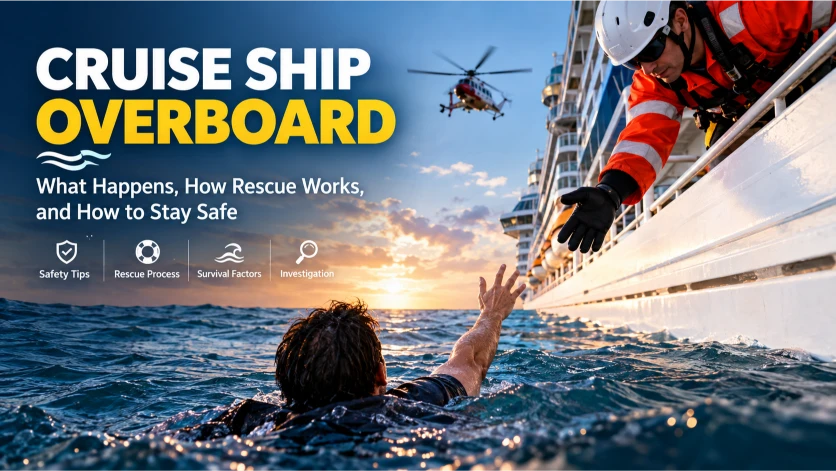
The phrase cruise ship overboard describes an incident in which someone goes over the side of a cruise ship and enters the water. Maritime crews commonly use the term man overboard for this type of emergency, regardless of the person’s gender.
These incidents do not all happen in the same way. Some may involve an accidental fall, while others may involve intentional actions or circumstances that require investigation. It is important not to assume the cause before reliable evidence is available.
Cruise ships are designed with passenger safety features, including railings in designated areas, crew procedures, and emergency communication systems. However, the ocean presents risks that are very different from those in a swimming pool or near a shoreline. A person in open water may be separated from the ship by wind and currents, while waves and poor lighting can make visual identification difficult.
Understanding a cruise ship overboard emergency therefore requires looking at three separate issues: how the incident is reported, how the rescue operation is organized, and how investigators establish what happened afterward.
How Often Do Cruise Ship Overboard Incidents Happen?
People often search for a single annual number of cruise ship overboard incidents. However, statistics need to be interpreted carefully because available reports may cover different vessels, locations, reporting periods, and types of incidents.
Some media articles repeat estimates of approximately 19 people going overboard in a year. That figure should not be presented as a verified worldwide total for 2026 without a source that clearly defines the population, time period, and method of counting. A number repeated across websites is not automatically an official statistic.
A useful starting point is the U.S. Department of Transportation’s Cruise Line Incident Reports. The department publishes quarterly reports under the Cruise Vessel Security and Safety Act framework. These records include reported overboard cases alongside other specified incidents. However, they should not be treated as a complete worldwide database of every event involving every cruise ship.
Readers should also understand the difference between a reported incident and a confirmed explanation. A person reported missing or overboard may be the subject of an ongoing investigation, and early information may not establish exactly what happened.
For responsible reporting, statistics should always include their source and date range. If a reliable source does not provide a global annual total, it is better to explain that limitation than to publish an unsupported figure.
What Happens When Someone Goes Overboard on a Cruise Ship?
When a crew member or passenger reports a person in the water, the ship’s emergency response begins. The exact procedure varies by vessel and circumstances, but several priorities are common.
1. The Crew Is Alerted
The first priority is to notify the bridge and the relevant crew members. The sooner the incident is reported, the sooner the ship can assess the situation.
A witness should communicate the approximate time and location of the fall and describe what they actually saw. If the person remains visible, that information may help responders track their position.
2. The Bridge Team Assesses the Situation
The bridge team evaluates the available information and initiates the ship’s man-overboard procedures. Depending on the circumstances, the vessel may change course or speed and begin maneuvers intended to support the search.
A large ship cannot necessarily stop instantly or turn as easily as a small boat. Maneuvering must account for navigation, sea conditions, nearby vessels, and the safety of everyone aboard.
3. The Search Begins
Crew members may scan the surrounding water, use available equipment, and coordinate the response with nearby vessels or maritime rescue authorities. The methods used depend on the ship’s equipment, location, and environmental conditions.
A cruise ship overboard search becomes more challenging when the person’s exact entry point is unknown or the report comes after a delay.
4. The Crew Coordinates the Response
Communication helps the bridge, deck teams, security personnel, and outside responders share information. The last known location, observations from witnesses, and any relevant detection alerts may help responders plan the search.
The ship may also need to communicate with maritime authorities about the incident and the assistance required.
5. The Incident Is Documented
After the immediate emergency response, the cruise line and relevant authorities may preserve records and gather evidence. The extent of any investigation depends on the circumstances and the laws that apply.
A missing person report, a confirmed fall, and a suspected criminal act are not interchangeable descriptions. Reliable reporting should use the terminology supported by the available evidence.
How Does a Cruise Ship Overboard Rescue Operation Work?
A cruise ship overboard rescue operation is a coordinated search and recovery effort. It may involve the ship’s bridge team, trained crew, rescue equipment, nearby vessels, and maritime authorities.
The first challenge is to establish the person’s last known position. Information from a witness can be particularly useful because it may help responders identify the starting area for the search. If no one saw the event, the timeline and location may be harder to determine.
The second challenge is locating the person. Waves, wind, currents, darkness, and poor visibility can make a person in the water difficult to see. Responders may need to search an area rather than a single fixed point.
The third challenge is recovery. Even after the person is located, sea conditions and the ship’s position may affect how rescuers can safely bring them aboard or transfer them to another vessel.
Not every incident involves the same equipment or agencies. A rescue near a coastline may have different available resources from an incident far offshore. The ship’s position, the weather, and the distance to other vessels all influence the response.
The most useful action a witness can take is to report the incident immediately and provide accurate information. Do not delay notifying the crew while trying to record a video or gather details.
Can Someone Survive Falling Overboard From a Cruise Ship?
Yes, survival is possible, but it cannot be predicted from a single factor. The outcome of a cruise ship overboard incident depends on the circumstances of the fall, the person’s condition, the water, and how quickly rescuers can locate and recover them.
Water Temperature
Cold water can cause the body to lose heat and can impair movement and judgment. The effects depend on the temperature, exposure time, clothing, and the person’s physical condition.
Waves and Currents
Waves may make breathing and staying afloat more difficult. Wind and currents can move a person away from the initial location, complicating efforts to find them.
Injuries and Exhaustion
A fall may cause injuries, and swimming in open water can quickly become exhausting. A person’s ability to stay afloat may also be affected by clothing, physical condition, and the surrounding sea.
Time Until Rescue
The time needed to locate and recover a person is an important factor. A prompt alert can help responders begin the search sooner, but a quick response does not guarantee survival.
There is no reliable universal rule that determines how long a person can survive after going overboard. Conditions differ considerably, so claims promising a specific survival time should be treated cautiously unless they are grounded in appropriate medical or rescue evidence.
Why Is It Difficult to Find Someone in the Ocean?
Finding a person in open water is a complex search problem. The difficulty is not simply the distance between the ship and the person; it is also the changing environment.
Visibility can be poor. A person’s head may be hard to distinguish from waves, especially at night or in bad weather. Clothing, lighting, and the height of the observer can affect visibility.
The search area can change. Wind and currents may move a person from the initial location. The ship also continues to move until the bridge team can carry out the appropriate maneuver.
Weather affects equipment and people. High waves, rain, darkness, and strong winds can make observation and recovery more difficult. They may also restrict the safe use of rescue craft.
The report may be delayed. If nobody witnesses the event, the time and location may be uncertain. This can make it harder for responders to decide where to focus their efforts.
These challenges explain why early reporting and clear communication are central to a man-overboard emergency. They also explain why a successful outcome cannot be guaranteed, even when a search operation is conducted.
Cruise Ship Overboard Detection Technology
Technology can help a crew identify a possible fall or gather information about an incident. However, the equipment available varies between ships, and no single detection method works perfectly in every condition.
Surveillance Cameras
Cameras may record activity in areas covered by the ship’s surveillance system. If an incident is reported, available footage may help investigators establish a timeline or review the circumstances.
Cameras have limitations. They may not cover every location, and image quality can be affected by lighting, weather, distance, and obstructions.
Man-Overboard Detection Systems
Dedicated man-overboard detection systems are designed to identify a possible person entering the water and alert crew members. Depending on the equipment, detection may use cameras, sensors, or automated image analysis.
The system’s effectiveness depends on its design and operating conditions. An alert may need to be checked by crew members, and an absence of an alert does not prove that no incident occurred.
Artificial Intelligence and Thermal Imaging
Artificial intelligence can be used to analyze images and identify patterns that may indicate a person has entered the water. Thermal imaging is another technology that may assist observation under suitable conditions.
These tools can support a search, but their capabilities depend on installation, visibility, environmental conditions, and system performance. They should not be described as foolproof.
What Does U.S. Law Require?
U.S. passenger-vessel law includes provisions related to safety and security. Under 46 U.S.C. § 3507, applicable requirements include technology capable of capturing images of passengers or detecting passengers who have fallen overboard, to the extent such technology is available.
The law’s applicability depends on the vessel and the relevant legal framework. It does not mean that every cruise ship worldwide has identical equipment or that detection is guaranteed in every incident.
For further background, the U.S. Department of Transportation’s passenger cruise ship information page links to government information about cruise ship safety and passenger resources.
What Should You Do If You Witness a Cruise Ship Overboard Incident?
If you see someone enter the water, act promptly but do not put yourself in danger. Your report may provide information that helps the crew begin its response.
- Notify the crew immediately. Use the nearest safe way to alert a crew member or follow the ship’s emergency instructions.
- Give the location and time. Explain where you saw the person and approximately when it happened.
- Describe what you actually observed. If you can safely maintain visual contact from a secure position, tell the crew where the person appears to be.
- Follow instructions. Let trained crew members coordinate the emergency response.
- Avoid dangerous rescue attempts. Do not climb over the railing or jump into the water. Doing so could create another emergency.
- Be accurate when giving information. Distinguish what you witnessed from what you heard from others. Do not spread speculation online.
If you are uncertain whether someone has fallen, report the concern rather than waiting until you have absolute proof. The crew can assess the information and decide what action is needed.
What Causes Cruise Ship Overboard Incidents?
There is no single cause that explains every cruise ship overboard event. Each case needs to be evaluated using reliable evidence, and early reports may not establish whether the event was accidental, intentional, or connected to another circumstance.
Possible circumstances include:
- Accidental falls: A person may lose balance or fall near an exposed area.
- Unsafe behavior: Climbing or sitting on railings creates a serious risk of falling.
- Alcohol-related impairment: Alcohol can affect balance and judgment, but it should not be blamed for an individual incident without evidence.
- Medical or personal emergencies: Some events may involve circumstances that require careful assessment.
- Suspected intentional actions or criminal activity: Authorities may investigate these possibilities when the evidence warrants it.
Investigators may review available surveillance footage, witness accounts, ship records, and other relevant evidence. The purpose is to establish what can be supported by the facts rather than to rely on assumptions.
For readers, the key distinction is between a confirmed finding and a possible explanation. A headline or social media post may describe an incident before investigators have completed their work.
Practical Cruise Ship Safety Tips for Passengers
Passengers cannot control every emergency, but they can reduce avoidable risks by following basic safety practices.
Stay Behind Railings
Never climb, sit, or lean dangerously over safety barriers. Railings are designed to help protect people from falling, not to serve as seating or climbing structures.
Take Care on Open Decks
Wind, wet surfaces, and ship movement can affect balance. Use designated walkways, hold handrails where appropriate, and follow signs restricting access to particular areas.
Drink Responsibly
Alcohol can reduce awareness and coordination. Be particularly cautious near open deck edges, stairs, and wet surfaces.
Supervise Children
Keep children under appropriate supervision in open deck areas. Explain clearly that railings must never be climbed and that crew instructions must be followed.
Report Hazards
If you notice a damaged barrier, a slippery walkway, or another possible hazard, report it to a crew member. Do not assume another passenger has already reported it.
Learn the Ship’s Emergency Procedures
Pay attention to the safety briefing and understand how to contact the crew. Knowing how to report an emergency can save valuable time.
These precautions do not eliminate every risk, but they support safer behavior during a cruise and help passengers respond more effectively if they see a potential emergency.
How Are Cruise Ship Overboard Incidents Investigated?
The investigation following a cruise ship overboard incident depends on the facts, the location, and the applicable laws. The cruise line may document the event, while maritime authorities or law enforcement agencies may become involved when their jurisdiction applies.
Investigators may examine witness statements, available surveillance footage, ship records, communication logs, and other evidence. These sources can help establish a timeline, identify the last known location, and assess the circumstances.
Jurisdiction is not always straightforward. The FBI explains that its authority over serious crimes aboard cruise ships can depend on factors such as the ship’s location, ownership, flag state, nationality of the people involved, and the voyage’s departure and arrival points. Its official cruise ship crime guidance explains these considerations and provides information about reporting certain crimes.
An overboard incident does not automatically mean a crime occurred. Some cases may be treated as accidents or missing-person investigations; others may require further scrutiny. Investigators must assess the available evidence before drawing conclusions.
Public records also have limitations. A government report may record an allegation or missing-person case without providing a final explanation. Readers should therefore avoid treating every entry in an incident database as a fully resolved case.
Where Can You Check Reliable Cruise Ship Incident Information?
When researching a specific incident or writing about cruise ship safety, use primary sources wherever possible.
- U.S. Department of Transportation: Cruise Line Incident Reports — quarterly reports of specified incidents reported under the U.S. cruise-ship reporting framework.
- FBI: Crimes Onboard Cruise Ships — explains the FBI’s jurisdiction and reporting guidance for certain serious crimes and suspicious deaths or missing U.S. nationals.
- U.S. Department of Transportation: Passenger Cruise Ship Information — provides government resources on cruise passengers, vessel safety, and related issues.
- 46 U.S.C. § 3507 — the statutory text covering relevant cruise-vessel security and safety requirements.
One important limitation: U.S. reporting resources do not represent every cruise ship and every incident worldwide. For an event outside the scope of those records, the relevant maritime authority or local law enforcement agency may be a more appropriate source.
Frequently Asked Questions About Cruise Ship Overboard Incidents
1. What happens when someone goes overboard on a cruise ship?
The crew is alerted and initiates the vessel’s relevant emergency procedures. The bridge team assesses the situation, the search begins, and outside rescue services may be contacted depending on the circumstances.
2. How common are cruise ship overboard incidents?
The answer depends on the reporting source, time period, and definition used. Avoid treating a widely repeated estimate as an official worldwide total unless the source clearly supports that claim.
3. Can someone survive falling overboard from a cruise ship?
Yes, survival is possible, but the outcome depends on injuries, water temperature, sea conditions, flotation, and the time needed to locate and recover the person.
4. Do cruise ships have man-overboard detection systems?
Some ships use dedicated detection technology, while equipment and procedures vary between vessels. Detection systems can assist the crew but cannot guarantee that every incident will be identified.
5. How long does a cruise ship overboard rescue take?
There is no fixed duration. The time depends on when the event is reported, how easily the person can be located, the weather, and the rescue resources available.
6. Why is it hard to find someone in the ocean?
Waves, darkness, wind, currents, and the ship’s movement can make a person difficult to locate. A delayed report may also leave rescuers uncertain about the starting point of the search.
7. What should I do if I see someone fall overboard?
Alert a crew member immediately, report the last known location, and follow the ship’s instructions. If safe, maintain visual contact from a secure place without leaning over the railing.
8. Can surveillance cameras help investigate an overboard incident?
Available footage may help investigators review a timeline or the circumstances, but cameras do not necessarily cover every area. The usefulness of recordings depends on their availability and quality.
9. Are cruise lines required to report every overboard incident?
Requirements depend on the applicable law, vessel, and circumstances. U.S. reporting rules cover specified incidents within their legal framework, but those reports should not be assumed to represent all incidents worldwide.
10. How can passengers reduce the risk of falling overboard?
Stay behind safety barriers, avoid climbing on railings, take care on wet decks, drink responsibly, supervise children, and follow crew instructions.
Conclusion: Understanding Cruise Ship Overboard Safety
A cruise ship overboard emergency is difficult because finding and recovering a person in open water can involve changing weather, limited visibility, and an uncertain search area. The crew’s response begins with reporting and assessment, followed by the appropriate search and rescue procedures. Technology can support detection and investigation, but no system guarantees a successful outcome.
Passengers can make a practical difference by reporting a possible fall immediately, giving accurate information, avoiding dangerous rescue attempts, and following crew instructions. Readers researching individual cases should also distinguish confirmed facts from speculation and check the reporting period and scope of any statistics they use.
For reliable information, start with official government resources and use figures only when their definitions and dates are clear. This approach provides a more accurate understanding of cruise ship overboard incidents than relying on dramatic headlines or unsupported estimates.
Related Articles
Explore more guides from our website:
- Sean Patrick Thomas: Biography and Career — Learn about the actor’s life, movies, and television career.
- How Tall Is Tom Welling? — Discover the actor’s height and career highlights.
- Social Security Administration — Read our guide to Social Security information and benefits.
- UEFA Champions League 2026/27 — Explore our guide to the upcoming European club football season.